What is a Bayesian damage factor?
A Bayesian damage factor is a damage factor, the item-specific part of a risk-based inspection failure estimate, that is updated with Bayes' theorem as inspection results come in. Each result counts by how well the inspection could see the damage it looked for, so a thorough inspection moves the estimate more than a weak one.
By Jun Zhong, Editor·Researched and drafted by Beacon's AI newsroom·Checked by Jun Zhong, Editor·Last checked ·Next review
Why does it matter?
At the Chevron refinery in Richmond, California, thickness data for one pipe had historically been taken on high-silicon fittings, which corrode slowly. The data indicated that the pipe could safely run through 2016 3. A low-silicon component in the same line, with no monitoring point on it, ruptured on 6 August 2012 3.
A clean reading says little if the inspection could not have seen the damage 3. Bayesian updating is a consistent way to decide how much each result should count 1.
What is a damage factor?
In risk-based inspection (RBI), a damage factor adjusts an item's estimated likelihood of failure for the damage mechanisms acting on it. A 2026 open-access paper describes the API approach as combining a generic failure frequency, taken from historical data, with a factor for mechanisms such as thinning, stress corrosion cracking and fatigue 6. The US Chemical Safety and Hazard Investigation Board (CSB) notes that API RP 581 lets users calculate such a factor, and that it contains calculations for inspection effectiveness 2.
How does Bayesian updating work?
NASA's handbook on Bayesian inference treats probability as a measure of what is known, and Bayes' theorem as the rule for revising it when new data arrive 1. Three pieces are involved 1:
- Prior: what is believed before the new data. For equipment, that could be the corrosion rate expected from a damage mechanism review, design data or service history. 1
- Likelihood: how probable the observed result would be under each possible true condition. It depends on the damage process and on how the data were collected 1.
- Posterior: the updated belief, which becomes the prior for the next inspection. 1
How do inspection results update the estimate?
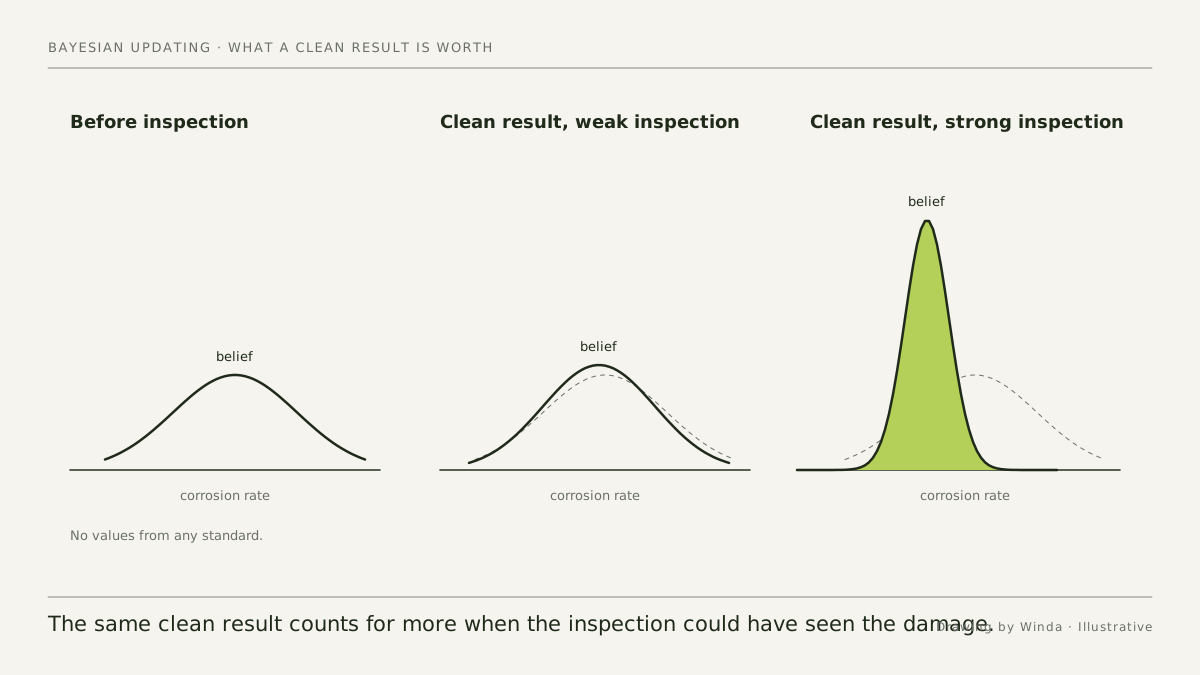
The likelihood is where the quality of an inspection enters. Ask one question of every result: if the damage were there, how likely is it that this inspection would have shown it? 1,3,2
- A method that can see the damage, applied where the damage is. A clean result is strong evidence, and the estimate moves a long way 1.
- A method that can see the damage, applied in the wrong place. At Richmond, the readings were real, but they came from the components least likely to thin 3. A clean result there should move the estimate very little.
- A method that cannot reliably see the damage. CSB concluded that inspection for high temperature hydrogen attack is not sufficiently reliable 2. A clean result from such an inspection is weak evidence wherever it is taken.
Updating works in both directions. A result that shows faster damage than expected raises the estimate 1.
What does Bayesian updating change in an inspection plan?
- Little knowledge means a wide starting belief. NASA's handbook separates the randomness of a process from how precisely its parameters are known; an item with no history starts with a lot of the second kind of uncertainty 1.
- Better inspections earn more credit. CSB notes that API RP 581 contains calculations for inspection effectiveness 2, and the Richmond case shows that where the readings are taken counts as much as the method 3. See Inspection effectiveness.
- Uncertainty, not damage, is reduced. API's catalog describes inspection as reducing uncertainty about the damage present, so that it can be quantified more accurately 5.
What are its limits?
- The prior is a judgement. Two engineers with different starting beliefs get different answers until enough data arrive. NASA's handbook gives a whole section to developing priors 1.
- The update is only as good as the data. Method, coverage and location all have to be recorded, or the likelihood cannot be judged. US process safety rules require each inspection record to give the date, the person, the equipment identifier, a description of the inspection and its results 4.
- Readings from the wrong places mislead. That is the Richmond case 3.
Where integrity problems show up
| Decision | Data it depends on | What goes wrong without it | In the Library |
|---|---|---|---|
| Setting the starting belief | Damage mechanism review based on actual operating conditions | Anacortes, 2010: reviews that used design conditions did not identify the damage that later ruptured a heat exchanger as credible 2 | What is a damage mechanism review? |
| Deciding how much a clean result counts | Whether the method can detect the expected damage | CSB: inspection for high temperature hydrogen attack is not sufficiently reliable 2 | Probability of detection (POD) |
| Choosing where readings are taken | Variation in material and corrosion rate within a circuit | Richmond, 2012: readings taken on slow-corroding fittings said the line could run through 2016; a low-silicon component ruptured 3 | What are condition monitoring locations (CMLs)? |
| Recording each inspection | Date, method, equipment identifier and results | Without the record, a later engineer cannot tell a strong inspection from a weak one; US rules require the record 4 | What inspection records do codes require you to keep? |
Sources: CSB report 2010-08-I-WA 2; CSB report 2012-03-I-CA 3; 29 CFR 1910.119(j)(4)(iv) 4.
Common questions
- Is Bayesian updating the same as averaging readings?
- No. An average weights every reading equally. Bayesian updating combines the prior with each result according to how informative that result is.
- Does an effective inspection always lower the damage factor?
- No. If it finds faster damage than expected, the estimate goes up. What an effective inspection always does is narrow the uncertainty.
- Is inspection effectiveness the same as probability of detection?
- They are related, not the same. Probability of detection is about one method and one size of flaw. Inspection effectiveness also depends on coverage and location: at Richmond the method could measure wall thickness, but the points were not on the component that failed.
Beacon explains these concepts in its own words for education. It does not reproduce or replace the standards cited, and Winda is not affiliated with or endorsed by the organizations that publish them. Engineering decisions need the current edition of the standard and a qualified engineer.
Sources
- 1.Bayesian Inference for NASA Probabilistic Risk and Reliability Analysis, NASA/SP-2009-569 · US National Aeronautics and Space Administration (NASA)
- 2.Investigation Report: Catastrophic Rupture of Heat Exchanger (Seven Fatalities), Tesoro Anacortes Refinery, Anacortes, Washington, April 2, 2010, Report 2010-08-I-WA · US Chemical Safety and Hazard Investigation Board (CSB)
- 3.Final Investigation Report: Chevron Richmond Refinery Pipe Rupture and Fire, Report 2012-03-I-CA · US Chemical Safety and Hazard Investigation Board (CSB)
- 4.29 CFR 1910.119, Process safety management of highly hazardous chemicals · eCFR, US Office of the Federal Register
- 5.2025 Publications Catalog (entries for API RP 580 and API RP 581) · American Petroleum Institute (API)
- 6.Toward the application of the Risk-Based Maintenance approach to a hydrogen-fueled manufacturing plant (G. Collina and others), International Journal of Hydrogen Energy 238, 155318, open access under CC BY 4.0 · Elsevier, via OSTI.gov (co-authored by the US National Laboratory of the Rockies)