What is API 581?
·Updated ·9 sources
API RP 581, Risk-Based Inspection Methodology, is the American Petroleum Institute's quantitative method for building a risk-based inspection program for pressurized fixed equipment: pressure vessels, piping, tanks, relief devices and exchanger tube bundles. It is the calculation companion to API RP 580. The current edition is the 4th, published in January 2025.
By Jun Zhong, Editor·Researched and drafted by Beacon's AI newsroom·Checked by Jun Zhong, Editor·Last checked ·Next review
Why does it matter?
On 2 April 2010 a heat exchanger ruptured at the Tesoro refinery in Anacortes, Washington, and seven workers died 3. The steel had been weakened by high temperature hydrogen attack (HTHA) 3. The US Chemical Safety and Hazard Investigation Board (CSB) later ran the API RP 581 calculation for that damage, using the exchanger's design conditions and 38 years of service. The result was the lowest susceptibility class 3. CSB found that the exchangers had at times likely run under harsher conditions than the design figures used in the plant's reviews, and that the edition of RP 581 then in force did not require users to verify actual operating conditions 3,9.
A risk ranking is only as good as the data fed to it 3. That is the reason to understand what this document is, and what it is not.
Which edition of API 581 is current?
| API listing | Edition shown |
|---|---|
| Standards Plan 2 | 4th edition, published 30 January 2025; addenda to it are in development |
| 2025 Publications Catalog 1 | 3rd edition, April 2016, with Addendum 1 (April 2019) and Addendum 2 (October 2020), 632 pages |
API's printed 2025 catalog still shows the 3rd edition, while its Standards Plan, which lists publication dates edition by edition, records the 4th edition of January 2025 2,1. Anything written before 2025, including CSB's reports, refers to an earlier edition.
The title has changed over time. CSB's 2014 report cites the 2008 edition as Risk-Based Inspection Technology; the catalog title today is Risk-Based Inspection Methodology 1,3.
What does API 581 cover?
API's catalog describes RP 581 as quantitative procedures for setting up an inspection program by risk-based methods for pressurized fixed equipment, and names pressure vessels, piping, tanks, pressure relief devices and heat exchanger tube bundles 1. In API's description the method works out risk from the probability of a failure and its consequence, where failure means loss of containment 1.
It is one of a pair. CSB describes API RP 580 as the API standard for developing a risk-based inspection (RBI) program and API RP 581 as the standard for implementing one 3. See API 580 vs API 581: what is the difference?.
Risk-based inspection also reaches storage tanks through another API standard. EPA's guidance for oil spill prevention inspectors notes that under API 653 a tank's internal inspection interval can be set from corrosion rates or from an RBI assessment, and that RBI may lengthen or shorten the interval 4.
How does the method work, in outline?
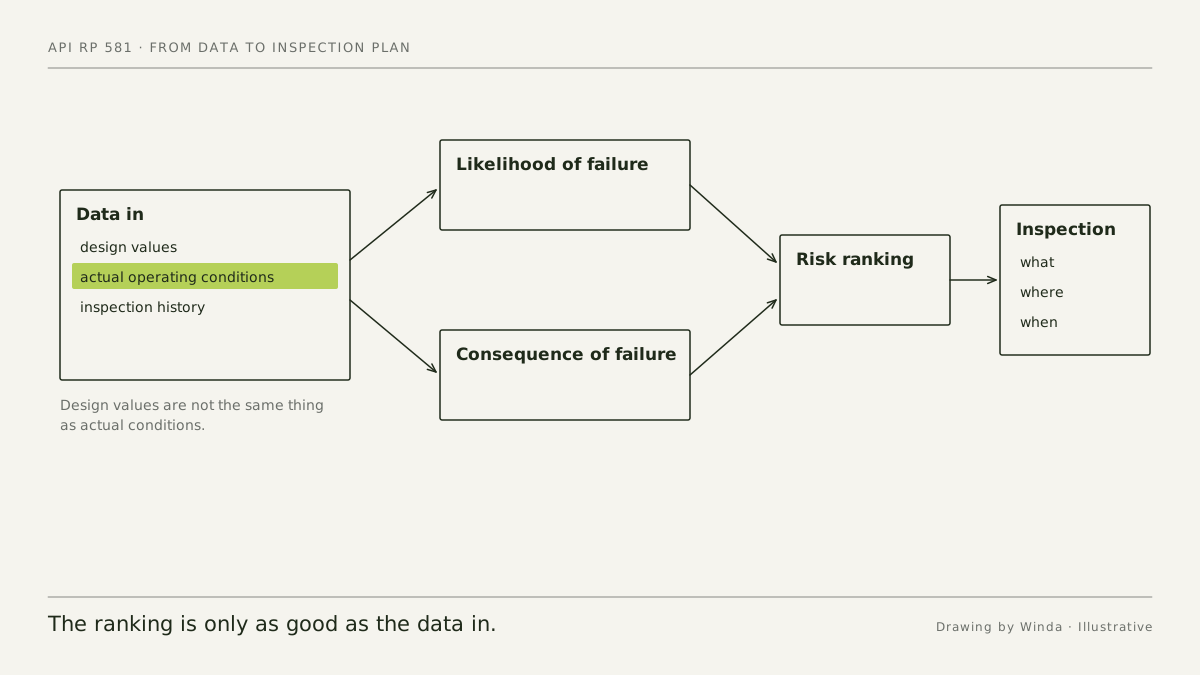
Public documents describe the idea 3,5:
- The aim. CSB summarizes API's intent for RBI: to optimize inspection effort by weighing the time between inspections against the risk of failure from known damage mechanisms 3.
- Likelihood. A 2026 open-access paper describes the API approach as combining a generic failure frequency, taken from historical data, with a factor for the damage mechanisms at work, such as thinning, stress corrosion cracking, HTHA and fatigue 5. CSB notes that RP 581 lets users calculate a damage factor, and that it contains calculations for inspection effectiveness 3.
- Ranking. In the same paper, equipment is ranked by risk, and items with higher risk are inspected or maintained more often 5. See Risk target.
Is API 581 mandatory?
No. It is a recommended practice, and CSB found it "written permissively": the report counted 19 uses of "shall" in RP 581 and judged none of them substantive, because nearly all sit in calculations that are themselves optional 3.
It still matters in enforcement. The US process safety management standard requires inspection and testing to follow recognized and generally accepted good engineering practices. OSHA's 2017 refinery publication names API 510, API 570 and API 580 as examples of such practices for vessel and piping inspection 6.
What have investigators said about API 581?
The CSB report on Anacortes, and CSB's 2016 follow-up on its recommendation, are the main public review of the document 3,9:
- Inputs were not verified. The 2nd edition of RP 581 did not require users to check actual operating conditions when deciding which damage mechanisms apply. With design conditions, the HTHA calculation gave the lowest susceptibility class for the exchanger that later ruptured 3,9.
- Inspection has limits. CSB concluded that inspection for HTHA is not sufficiently reliable, so a plan that relies on finding this damage by inspection is weak. 3,9
- Recommendation to API. CSB recommended that API revise RP 581 to set minimum "shall" requirements, to prohibit carbon steel in HTHA-susceptible service and to require verification of actual operating conditions 9.
- What API changed. API published the 3rd edition in April 2016. CSB found that it did add the requirement to verify operating conditions for HTHA, but not the rest, and on 4 October 2016 closed the recommendation as "Closed, Unacceptable Action" 9.
Where integrity problems show up
| Decision | Data it depends on | What goes wrong without it | In the Library |
|---|---|---|---|
| Which damage mechanisms to model | Actual operating conditions, not only design values | Anacortes, 2010: reviews relied on design conditions, and the HTHA calculation gave the lowest susceptibility class; the exchanger ruptured and seven workers died 3 | What is a damage mechanism review? |
| How much credit an inspection earns | Whether the method can find the damage in question | CSB: inspection for HTHA is not sufficiently reliable 3. UK refinery: four spot thickness points missed a local thin area and the line ruptured 8 | Inspection effectiveness |
| Where to measure | Coverage of every component in a circuit | Richmond, 2012: no thickness monitoring point sat on the low-silicon pipe component that failed 7 | What are condition monitoring locations (CMLs)? |
| When to open a tank | Corrosion rates or an RBI assessment | EPA: an RBI assessment can lengthen or shorten a tank's internal inspection interval 4 | How are inspection intervals set for vessels, piping and tanks? |
Sources: CSB report 2010-08-I-WA 3; EPA SPCC guidance, Chapter 7 4; CSB report 2012-03-I-CA 7; HSE safety alert CEMHD2-2019 8.
Common questions
- What is the latest edition of API 581?
- The 4th edition, published on 30 January 2025, according to API's own Standards Plan. API's 2025 printed catalog still lists the 3rd edition of April 2016 with its two addenda, so older references may name that one.
- What is the difference between API 580 and API 581?
- In API's words, restated: RP 580 introduces the principles of RBI and gives minimum general guidelines, while RP 581 provides the quantitative calculation methods. See [API 580 vs API 581: what is the difference?](/library/api-580-vs-api-581/).
- Does API 581 cover pipelines?
- API's scope description lists pressurized fixed equipment and does not name pipelines. Pipelines in the United States have their own integrity management rules; see [What is pipeline integrity management?](/library/pipeline-integrity-management/).
Beacon explains these concepts in its own words for education. It does not reproduce or replace the standards cited, and Winda is not affiliated with or endorsed by the organizations that publish them. Engineering decisions need the current edition of the standard and a qualified engineer.
Sources
- 1.2025 Publications Catalog (entries for API RP 580 and API RP 581) (API RP 581, 3rd edition, April 2016, with Addendum 1 (April 2019) and Addendum 2 (October 2020)) · American Petroleum Institute (API)
- 2.API Standards Plan: Industry Standards in Development (API RP 581, 4th edition, published 30 January 2025) · American Petroleum Institute (API)
- 3.Investigation Report: Catastrophic Rupture of Heat Exchanger (Seven Fatalities), Tesoro Anacortes Refinery, Anacortes, Washington, April 2, 2010, Report 2010-08-I-WA · US Chemical Safety and Hazard Investigation Board (CSB)
- 4.SPCC Guidance for Regional Inspectors, Chapter 7: Inspection, Evaluation, and Testing · US Environmental Protection Agency (EPA) ·
- 5.Toward the application of the Risk-Based Maintenance approach to a hydrogen-fueled manufacturing plant (G. Collina and others), International Journal of Hydrogen Energy 238, 155318, open access under CC BY 4.0 · Elsevier, via OSTI.gov (co-authored by the US National Laboratory of the Rockies)
- 6.Process Safety Management for Petroleum Refineries: Lessons Learned from the Petroleum Refinery Process Safety Management National Emphasis Program (OSHA 3918-08 2017) · US Occupational Safety and Health Administration (OSHA)
- 7.Final Investigation Report: Chevron Richmond Refinery Pipe Rupture and Fire, Report 2012-03-I-CA · US Chemical Safety and Hazard Investigation Board (CSB)
- 8.Catastrophic rupture of dead-leg pipe-work (Safety alert, Bulletin No. CEMHD2-2019) · UK Health and Safety Executive (HSE) ·
- 9.Recommendations Status Change Summary, Recommendation 2010-8-I-WA-R11 to the American Petroleum Institute (API RP 581) · US Chemical Safety and Hazard Investigation Board (CSB) ·