What are the three levels of a fitness-for-service assessment?
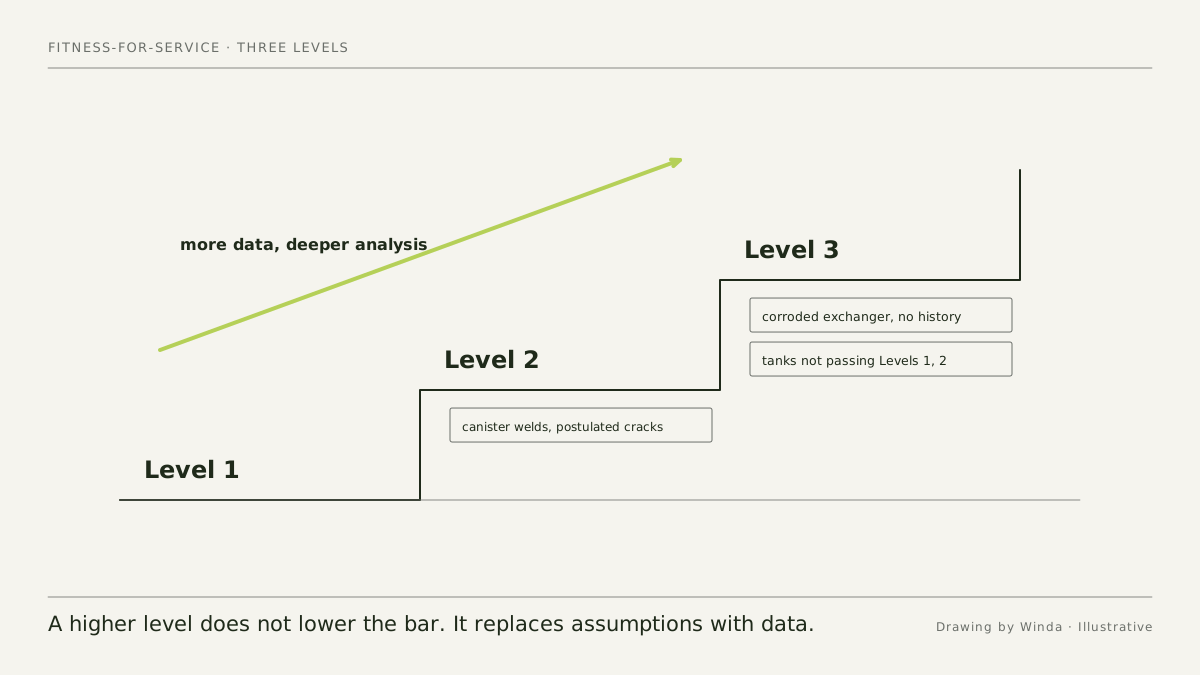
API 579-1/ASME FFS-1, the joint fitness-for-service standard of API and ASME, offers three levels of assessment. US regulators describe them as three levels of engineering calculation that scale with the data available. Each step up takes more data and deeper analysis. Published cases went to Level 3 where inspection history was missing or the flaw sat at a complex joint.
By Jun Zhong, Editor·Researched and drafted by Beacon's AI newsroom·Checked by Jun Zhong, Editor·Last checked ·Next review
Why does it matter?
On 8 July 2026 the US Pipeline and Hazardous Materials Safety Administration (PHMSA) proposed to accept API 579 for assessing metal loss on gas and hazardous liquid pipelines, and to name its second and third levels among accepted fracture mechanics methods for cracks 2. The proposal would bring the 2021 edition of API 579-1/ASME FFS-1 into the pipeline safety rules by reference 2. It is a proposal, not yet a final rule, and its comment period closed on 8 September 2026 2.
The levels are already applied to plant equipment such as heat exchangers and storage tanks 4,3. The proposal would carry them into pipeline regulation 2.
What do the three levels mean?
API 579-1/ASME FFS-1, Fitness-For-Service, is in its 4th edition, dated December 2021 1. API describes fitness-for-service assessments as quantitative engineering evaluations of whether an in-service component with a flaw or damage can keep operating, in support of run, repair or replace decisions 1. US federal documents describe the idea:
- Three levels that scale with data. PHMSA writes that API 579 has three levels of engineering calculation and analysis for each type of anomaly, and that they scale with the amount of data available 2.
- All three are rigorous. For corrosion metal loss, PHMSA describes the three levels as equal to, or more rigorous than, a Modified B31G calculation 2.
- The third level is the deepest. EPA's guidance for oil spill prevention inspectors describes three levels for brittle fracture in storage tanks, with the third normally using fracture mechanics and applied to tanks that do not pass the first two 3.
So a component that does not pass at one level is not automatically unfit. It can be taken to the next level, which asks for more data and more analysis 2,3.
Which level did published assessments use?
| Case | Damage | Level used | Why, as the document states it |
|---|---|---|---|
| Heat exchangers at a US national laboratory, 2025 4 | General metal loss, local metal loss and a crack-like weld flaw | Level 3 for all three | No documented inspection history; the flaw sat by a tube sheet joint, treated as a major structural discontinuity |
| Welded spent fuel canisters, 2016 study 5 | Postulated stress corrosion cracks | Level 2 | The authors note Level 3 is the recommended choice when a crack can grow in service; one Level 3 route needs safety factors from a risk assessment that was not available |
| Standard spent fuel canisters, 2026 study 6 | Postulated surface flaws | Level 2 | The authors followed the second level's procedure with weld residual stress included |
| Aboveground storage tanks, EPA guidance, 2013 3 | Risk of brittle fracture | Levels 1 and 2 first, Level 3 if needed | Level 3 normally uses fracture mechanics and is for tanks that do not pass the first two |
| Gas and liquid pipelines, PHMSA proposal, 2026 2 | Cracks | Level 2 or 3 | Named among technically accepted fracture mechanics methods |
Sources: Fermilab slides, OSTI 2573808 4; SRNL, OSTI 1254432 5; SRNL, OSTI 3686268 6; EPA SPCC guidance, Chapter 7 3; 91 FR 42272 2.
What does a higher level need?
The published cases show what changes as the level rises 4,5,2:
- More measurements. The 2025 laboratory case used wall readings on a two-dimensional grid, with extra readings around the thinnest spot, to build a three-dimensional model of the corroded part 4.
- More analysis. The same case ran an elastic-plastic stress analysis under the design-by-analysis rules of the ASME Boiler and Pressure Vessel Code, Section VIII, Division 2 4.
- Better material and stress data. The 2016 canister study found that weld residual stress had a strong influence on the result 5.
- Stated uncertainty. PHMSA's proposal would require anomaly evaluations to be done by a subject matter expert and to include uncertainties such as inspection tool tolerance 2.
What can the result of an assessment be?
- Fit for a stated period, with inspection. The 2025 exchangers were found fit for service at their original design conditions for 2.5 years, with an inspection at 1.25 years 4.
- Repair or replace. The same laboratory planned to replace the corroded parts 4.
- Re-rate. CSB notes that good practice includes re-rating a vessel when the code rules it was built to have since changed 7.
An assessment that is never done is its own failure. After the April 2018 explosion at the Husky Superior refinery in Wisconsin, where two vessels failed by brittle fracture, OSHA cited the refinery because equipment built of an older steel grade had never been through a fitness-for-service analysis 7. OSHA's 2007 refinery inspection program told its inspectors to ask for fitness-for-service assessment documents as part of each selected vessel's history file 8.
Do the levels apply to pipelines?
Not yet by rule in the United States. Today 49 CFR 192.712 names ASME/ANSI B31G and R-STRENG for corrosion metal loss on gas transmission pipe, and allows alternatives under conditions 9. PHMSA's July 2026 proposal would add API 579 for metal loss and list its second and third levels for cracks; until a final rule is published, the section applies as it stands 2,9. See ASME B31G vs RSTRENG: how is corroded pipe assessed?.
Where integrity problems show up
| Decision | Data it depends on | What goes wrong without it | In the Library |
|---|---|---|---|
| Whether to assess at all | Construction code and steel grade of older equipment | Superior, 2018: no fitness-for-service work had been done on vessels of an older steel grade; they failed by brittle fracture and OSHA cited the refinery 7 | What is brittle fracture? |
| Which level to use | Inspection history, whether a crack can grow, welds and joints nearby | National laboratory, 2025: with no inspection history and a joint close by, only the third level applied 4 | What is a local thin area assessment? |
| What goes into the calculation | Measurement tolerance, weld residual stress, material records | Canister study, 2016: adding weld residual stress changed the result strongly 5; PHMSA would require tool tolerance to be included 2 | How are crack-like flaws assessed for fitness-for-service? |
| How long to keep running | The assessment period and the inspection tied to it | The 2025 result held for 2.5 years and required an inspection at 1.25 years 4 | Remaining life |
Sources: CSB Husky Superior report 7; Fermilab slides, OSTI 2573808 4; SRNL, OSTI 1254432 5; 91 FR 42272 2.
Common questions
- Does every assessment start at Level 1?
- No. EPA describes the third level for tanks that do not pass the first two, but the 2025 laboratory case went straight to the third level because the first two did not apply to its conditions.
- Is a Level 3 assessment always finite element analysis?
- No. It depends on the damage. The 2025 case used elastic-plastic finite element analysis for metal loss. For brittle fracture in tanks, EPA says the third level normally uses fracture mechanics.
Beacon explains these concepts in its own words for education. It does not reproduce or replace the standards cited, and Winda is not affiliated with or endorsed by the organizations that publish them. Engineering decisions need the current edition of the standard and a qualified engineer.
Sources
- 1.2025 Publications Catalog (entry for API 579-1/ASME FFS-1) (API 579-1/ASME FFS-1, 4th edition, December 2021) · American Petroleum Institute (API)
- 2.Pipeline Safety: Repair Criteria for Hazardous Liquid and Gas Transmission Pipelines, proposed rule, 91 FR 42272, document 2026-13805 · US Pipeline and Hazardous Materials Safety Administration (PHMSA), Federal Register ·
- 3.SPCC Guidance for Regional Inspectors, Chapter 7: Inspection, Evaluation, and Testing · US Environmental Protection Agency (EPA) ·
- 4.Fitness for Service Assessment of a Corroded Heat Exchanger (A. Humenik, E. Voirin), FERMILAB-SLIDES-25-0171-AD, OSTI 2573808 · Fermi National Accelerator Laboratory, US Department of Energy, via OSTI.gov ·
- 5.Flaw Stability Considering Residual Stress for Aging Management of Spent Nuclear Fuel Multiple-Purpose Canisters (P.-S. Lam, R. L. Sindelar), SRNL-STI-2015-00680, OSTI 1254432 · Savannah River National Laboratory, US Department of Energy, via OSTI.gov ·
- 6.Flaw Tolerance Assessment for DOE Standard SNF Dry Storage Canisters (X.-K. Zhu, R. Sindelar, B. Wiersma), SRNL-STI-2026-00074, OSTI 3686268 · Savannah River National Laboratory, US Department of Energy, via OSTI.gov ·
- 7.Investigation Report: FCC Unit Explosion and Asphalt Fire at Husky Superior Refinery, Superior, Wisconsin, April 26, 2018 · US Chemical Safety and Hazard Investigation Board (CSB) ·
- 8.CPL 03-00-004, Petroleum Refinery Process Safety Management National Emphasis Program · US Occupational Safety and Health Administration (OSHA) ·
- 9.49 CFR 192.712, Analysis of predicted failure pressure and critical strain level · eCFR, US Office of the Federal Register